Before You Add Another AI Agent, Make Sure They Share the Same Plan
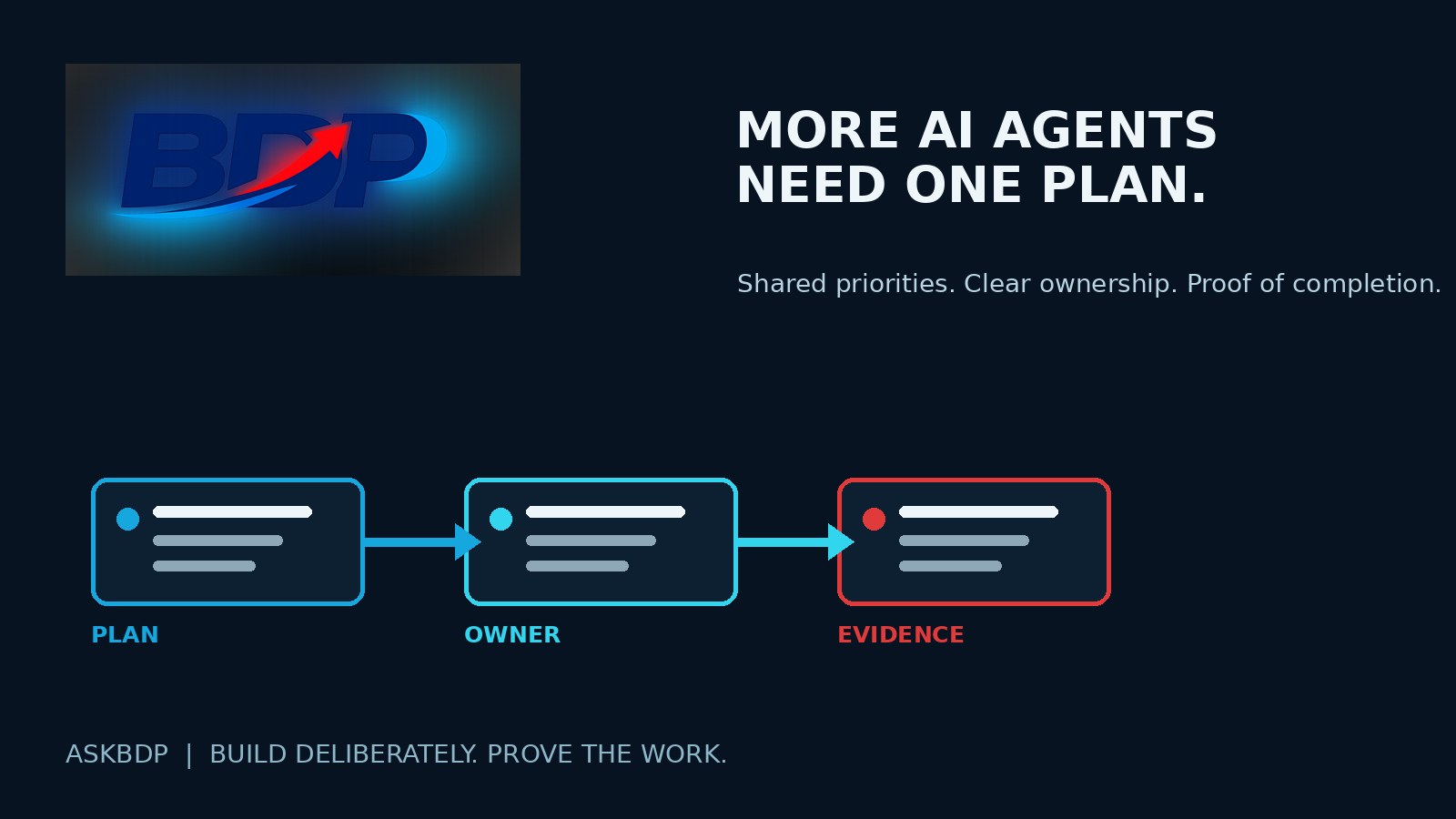
The fastest way to make an AI setup more expensive is to add another agent before the first ones can see the same plan.
One bot is drafting follow-up. Another is cleaning the CRM. A third is looking for prospects. A fourth is changing tags, content, or reporting. Each one can look useful on its own. Together, they can create a mess nobody meant to build.
The problem is not that the bots are weak. The problem is that they are working from different versions of reality.
A business can have a current offer in one document, old pricing in a campaign, a different priority in a chat thread, and a to-do list nobody owns. Give several agents access to that environment and they will move fast in different directions. Speed does not fix a missing plan. It makes the confusion happen sooner.
Before adding another AI agent, get five things straight.
1. Put the current plan in one place
Every agent needs the same plain-language brief: what the business is trying to accomplish right now, who the work is for, what is already active, and what is off limits.
That does not require a giant strategy deck. It can be a living page that names the current offer, target audience, active campaigns, approved messages, key dates, and the next few priorities. What matters is that it is current and easy to find.
If an agent has to guess whether an old campaign, price, or page is still active, it may act on information that should have been retired. That is how a cleanup turns into an accidental change in direction.
2. Give every task one owner
AI agents can help with the same project, but they should not all own the same decision.
Name the agent or person responsible for each task. One agent may prepare a draft. Another may check data. A human may approve anything that changes an offer, sends a message, or affects a customer record. The handoff should be clear enough that nobody has to ask, “I thought the other bot was doing that.”
This is the same discipline that keeps a small team from stepping on itself. AI does not remove the need for ownership. It makes ownership more important because the work can move before anyone notices a conflict.
3. Use a shared source of truth
A shared chat channel is not enough if the real instructions live in scattered files, old email threads, and someone’s memory.
Choose the place that holds the working truth for the project. It might be a CRM note, a project board, a shared document, or a simple operating brief. Then make sure the plan, task status, approved language, and decisions get updated there.
The goal is not to document every thought. The goal is to keep agents from acting on stale instructions. If a decision changes, the place they rely on must change too.
4. Set the approved scope before work starts
“Clean this up” is not a useful instruction for an agent with access to live systems.
Be specific. Can it identify problems only? Can it prepare a draft? Can it change tags? Can it pause a campaign? Can it send anything? Can it touch customer data? What must come back for approval first?
A clear scope protects the business and gives the agent a better chance of doing useful work. It also keeps a successful-looking task from creating work you did not authorize.
That matters when you are deciding whether to expand a business or make the first offer work. The same rule applies to AI work: do not let a new capability quietly become a new priority. Get clear on the work that matters first, then use the tools to support it.
5. Require evidence before calling it complete
An agent saying “done” is not the finish line.
Ask for the proof that fits the job: the changed record, the draft, the link, the report, the before-and-after status, or a list of items that need a human decision. For anything customer-facing, read it the way a customer would. For anything operational, verify the system where the change was supposed to happen.
Completion evidence gives the next agent something solid to work from. It also makes it easier to spot an unfinished handoff before it becomes a larger problem.
Add coordination before capacity
More agents can create more capacity. They do not automatically create more progress.
Start by making the work visible. Keep one current plan. Assign ownership. Set the limits. Require proof. Then decide where another agent would remove a real bottleneck.
If your business is sorting through the broader AI noise, the hidden trap is not always the tool itself. Often it is the lack of coordination around it.
The best AI setup is not the one with the most names, dashboards, or automations. It is the one where every agent knows the plan, knows its job, knows what it cannot change, and leaves the next person with clear evidence of what happened.